
Capacitive Sensor Pressure Transmitter: High Accuracy with Direct and Fully Digital Reading
Introduction
Pressure measurement and control is the most widely used process variable in industrial process control across many different sectors. Additionally, pressure can easily be used to infer several other process variables such as level, volume, flow and density.
In this article, we will discuss some details about the direct and fully digital pressure reading used in a pressure transmitter with a capacitive sensor.
Capacitive Sensors
These are among the most reliable sensors and have already been used in millions of industrial applications.
They are based on transducers in which the pressure applied to sensing diaphragms causes a variation in capacitance between them and a central diaphragm.
This capacitance variation is typically used to change the frequency of an oscillator or to act as an element in a capacitive bridge.
The variation in capacitance can therefore modify the oscillator frequency. This frequency can be measured directly by the CPU and converted into pressure.
In this case, there is no A/D conversion, which contributes to higher accuracy and eliminates drifts normally embedded in analog-to-digital conversions.
It is worth mentioning that this fully digital measurement principle has been used by SMAR since the 1980s. SMAR is the only Brazilian company and one of the few worldwide capable of manufacturing this type of sensor.
Capacitive sensors provide linear response and are practically insensitive to temperature variations, making them ideal for process instrumentation and control applications, offering excellent performance in terms of stability, temperature compensation and static pressure.
Some of their main advantages include:
-
Ideal for both low and high pressure applications
-
Minimize Total Probable Error (TPE) and therefore reduce process variability
-
Ideal for flow measurement applications
-
High rangeability with excellent accuracy due to linear response
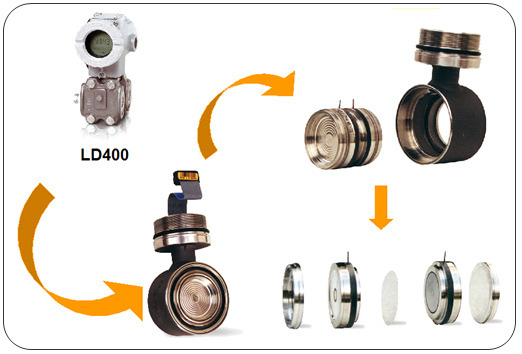
Figure 1 – Example of capacitive sensor construction
Maintaining the signal fully digital from the sensor to the CPU acquisition stage ensures significantly higher signal quality, eliminating thermal drift and degradation commonly associated with analog measurement methods used by most pressure transmitter manufacturers.
Digital measurement therefore significantly reduces Total Probable Error (TPE).
This direct digital measurement principle is used in all SMAR transmitters of the 300 Series and 400 Series (LD301, LD302, LD303, LD291, LD292, LD293 and LD400), as well as in the LD1.0 economical sensor.
Since 1988, when SMAR introduced the LD300 to the market, this principle has been applied, making SMAR the first company worldwide to offer a pressure sensor with direct and fully digital reading, providing highly accurate measurements and reducing process variability.
How Does the SMAR Capacitive Sensor Work?
The capacitive sensor consists of two main parts:
-
A mechanical structure, called the capacitive cell
-
An electronic circuit, essentially a resonant circuit
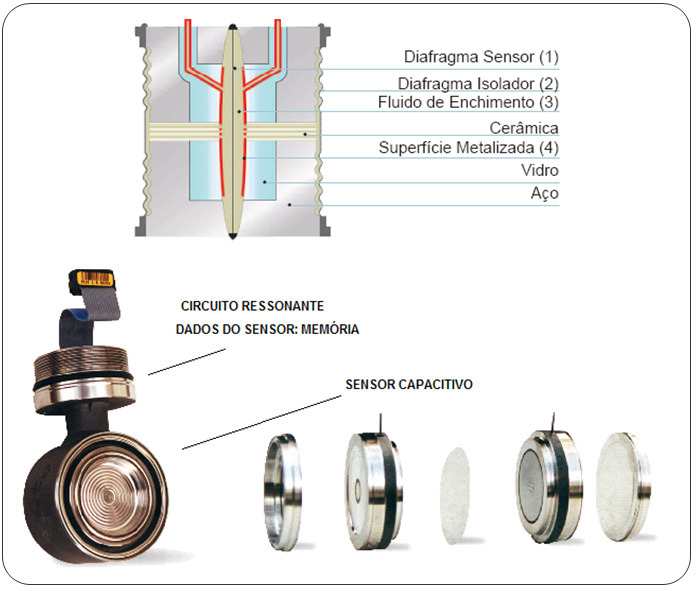
Figure 2 – SMAR Capacitive Pressure Sensor
In the center of the cell lies the sensing diaphragm. This diaphragm flexes according to the pressure difference applied to the right and left sides of the cell.
These pressures are applied directly to isolation diaphragms, which provide resistance against corrosion caused by process fluids.
The pressure is transmitted through the fill fluid to the sensing diaphragm, causing its deflection.
The sensing diaphragm acts as a moving electrode, while two metallized surfaces serve as fixed electrodes.
The diaphragm deflection is detected through the variation in capacitance between the fixed and moving electrodes.
Because the diaphragm movement is minimal, hysteresis is practically zero.
SMAR’s advanced sensor design ensures excellent linearity and repeatability, making the sensor highly reliable in terms of measurement and accuracy.
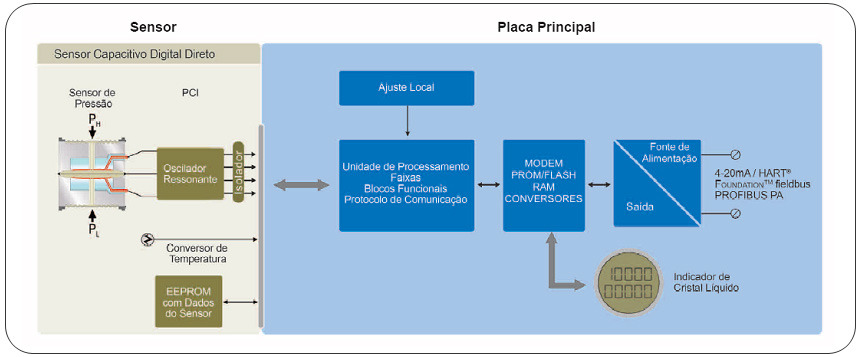
Figure 3 – Example of a SMAR Capacitive Transmitter:
LD301 (HART® / 4–20 mA), LD302 (Foundation Fieldbus), LD303 (PROFIBUS-PA)
The resonant electronic circuit reads the capacitance variation between the moving and fixed plates. The CPU conditions the signal and communicates according to the transmitter protocol.
Since there is no A/D conversion, errors and deviations during signal conversion are eliminated.
A temperature sensor provides temperature compensation, which combined with the pressure sensor accuracy results in high precision and wide rangeability across the SMAR transmitter series.
The process variable, monitoring data and diagnostic information are provided through digital communication protocols, including:
-
HART®
-
FOUNDATION™ Fieldbus
-
PROFIBUS PA
These protocols can be modified easily by replacing the internal electronic board or by downloading new firmware.
For example:
-
A HART® transmitter can become a FOUNDATION Fieldbus or PROFIBUS PA instrument by replacing the internal board
-
A Foundation Fieldbus device can become a PROFIBUS PA instrument simply by downloading the corresponding firmware
Challenging Digital Boundaries… SMAR Always Goes Further
SMAR constantly pushes technological boundaries. Its engineering team is continuously developing innovative products that will shape the market in the coming years.
One of these innovations is the HT3012 HART® super chip, a 4-in-1 processor designed to complement the transmitter microprocessor and deliver exceptional performance.
This chip includes:
-
Mathematical co-processor
-
HART modem
-
LCD controller
-
PWM converter (for the 4–20 mA signal)
Combined with the precision of the capacitive sensor, this architecture provides the high accuracy and rangeability characteristic of SMAR transmitters.
The HT3012 is a highly integrated chip, allowing SMAR transmitter series to use a single electronic board, simplifying maintenance and delivering one of the highest MTBF (Mean Time Between Failures) levels on the market.
To further enhance performance, temperature is continuously measured, and transmitter output is automatically compensated for temperature variation.
This high-performance architecture ensures fast response time, making the LD400 one of the fastest transmitters on the market.
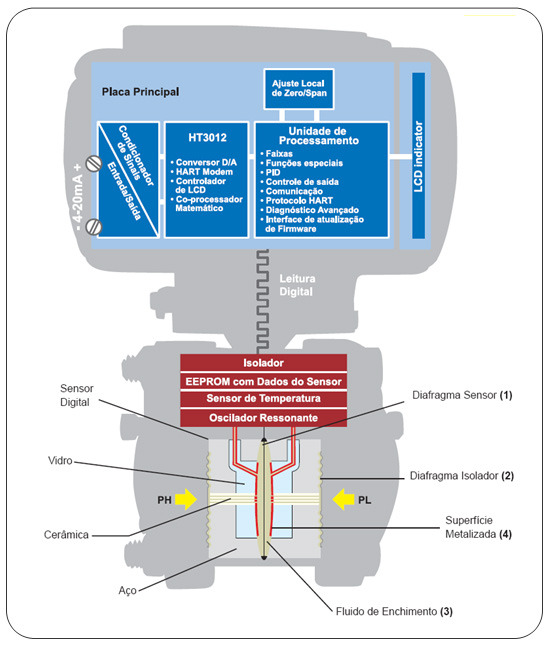
Figure 4 – LD400
Conclusion
SMAR transmitters were developed to be a robust and highly reliable solution for pressure measurement.
They offer great flexibility in industrial applications due to the capacitive sensor technology that maintains the signal fully digital from sensor reading to transmitter output, resulting in high resolution and highly accurate measurements.
All processing is handled by the HT3012 mathematical co-processor, ensuring fast response and high transmitter performance.
SMAR transmitters are the ideal choice to increase productivity and guarantee the reliability of your process.
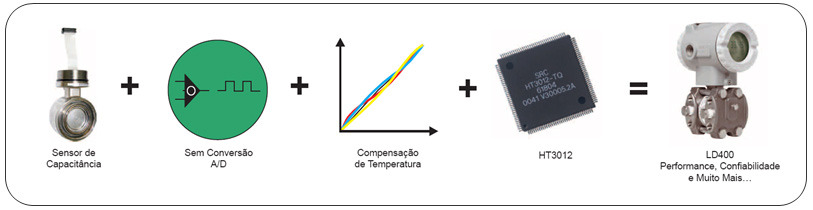
Figura 5 – Super Chip HT3012 & Sensor Capacitivo: Performance, Confiabilidade e muito mais...
-
Figure 5 – HT3012 Super Chip & Capacitive Sensor: Performance, Reliability and Much More
-
Author
César Cassiolato
-
For more information visit:
-
LD300 Series – Pressure, Level and Flow Transmitters
https://www.smar.com.br/pt/produto/ld300series-transmissores-de-pressao-nivel-e-vazao -
LD400 – HART Pressure Transmitters
https://www.smar.com.br/pt/produto/ld400-transmissores-de-pressao-hart -
LD1.0 – Economical Gauge Pressure Transmitter
https://www.smar.com.br/pt/produto/ld10-manometrica-economico
-
Related Links:
-
SMAR Technical Articles
https://www.smar.com.br/pt/artigos-tecnicos -
PROFIBUS Articles
https://www.smar.com.br/pt/artigos-tecnicos-profibus