
Industrial Systems Integration: the strategic role of instrumentation, automation, and industrial networks
Introduction
The growing complexity of industrial processes across multiple segments—such as sugar & ethanol, food and beverage, pulp & paper, mining, oil & gas, chemical, and biochemical industries—requires systems that are increasingly integrated, reliable, and data-driven. Industrial automation has moved beyond being merely an operational resource and has become a strategic pillar for productivity, safety, and operational excellence.
In this context, industrial systems integration plays a central role. Properly integrating instrumentation, industrial networks, and control platforms increases information processing speed, improves decision-making, and ensures more stable, efficient, and safe operations in industrial plants of different sizes and levels of complexity.
Industrial automation as the foundation of multisector efficiency
Regardless of the industrial segment, the challenges are similar: multiple process variables, the need for continuous control, loss reduction, increased availability, and growing demands for safety and reliability.
Industrial automation enables:
- Higher productivity and operational continuity
- Reduced energy and raw material consumption
- Improved product quality control
- Fewer unplanned shutdowns
- Operation closer to the plant’s nominal capacity
These benefits are only fully achieved when systems are properly integrated—from the field level to control and supervisory layers.
Systems integration: connecting field, control, and management
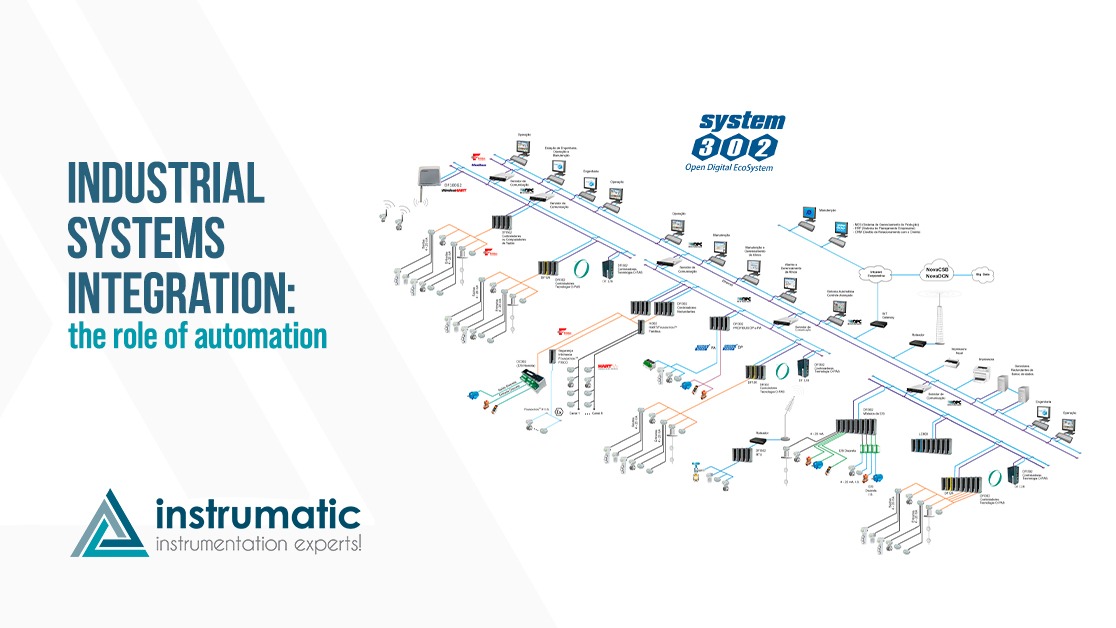
Efficient industrial systems integration depends on reliable communication between field instruments, controllers, industrial networks, and supervisory systems. This integration transforms raw data into useful information for process control, optimization, and management.
Well-integrated industrial plants feature:
- Greater operational reliability
- Faster response to process deviations
- Easier expansion and modernization
- Improved traceability of critical variables
In this context, systems integration is the link that connects the physical process to the digital intelligence of the industrial plant.
Essential equipment for industrial systems integration
Efficient systems integration depends directly on the correct selection of equipment that makes up the automation architecture. Key elements include:
Process instrumentation
Measurement instruments for pressure, flow, level, temperature, and density are the foundation of systems integration. They convert physical phenomena into reliable data that feeds industrial networks and control systems.
Properly specified instrumentation ensures:
- Accurate and continuous data
- Operational safety
- Process stability
- A reliable basis for technical and managerial decisions
Control and automation platforms
Programmable Logic Controllers (PLCs), digital controllers, and distributed control platforms are responsible for processing data received from instrumentation and executing control strategies.
These systems enable:
- Precise control of multiple variables
- Integration with industrial networks
- Scalability for new projects and expansions
- Reliable operation in harsh industrial environments
Industrial networks and communication
Digital industrial networks enable integration between instruments, controllers, and supervisory systems. They reduce wiring complexity, increase communication reliability, and support advanced diagnostics.
In addition, communication interfaces and converters are essential for integrating digital systems with analog instruments, enabling modernization and retrofit projects without the need to fully replace existing infrastructure.
Systems integration in new projects, expansions, and modernizations
Industrial systems integration is especially strategic in:
- New projects (greenfield)
- Industrial plant expansions
- Modernizations and retrofits (brownfield)
In these scenarios, proper definition of the instrumentation, network, and control architecture reduces risks, increases plant availability, and ensures a higher return on investment throughout the production lifecycle.
Instrumatic’s role in industrial systems integration
Instrumatic operates strategically in industrial systems integration, providing complete solutions in instrumentation, automation, and industrial communication for multiple segments of the process industry.
With a technical and consultative approach, Instrumatic supports:
- Specification of field instruments
- Definition of control architectures and industrial networks
- Integration between digital and analog systems
- Automation projects across different industrial segments
- Expansion and modernization of existing plants
This approach ensures integrated, reliable systems prepared to operate with high efficiency and safety.
Automation beyond the shop floor: integration as a business strategy
Modern automation goes beyond the shop floor. Well-integrated systems deliver consistent data that supports industrial management, performance analysis, and continuous process improvement.
Industrial systems integration enables:
- Greater operational predictability
- Improved asset management
- Cost optimization
- Support for digital transformation and Industry 4.0
Business automation becomes a natural outcome of efficient systems integration.
Conclusion
Industrial systems integration is a decisive factor for the competitiveness of modern industry. Reliable instrumentation, robust control platforms, and well-structured industrial networks form the foundation for safer, more efficient, and more sustainable operations across multiple industrial segments.
With technical expertise, a comprehensive portfolio, and a consultative approach, Instrumatic positions itself as a strategic partner in industrial systems integration, supporting customers in new projects, expansions, and modernizations with a focus on operational efficiency and reliability.
Contact Instrumatic and discover how our industrial systems integration solutions can transform your operation.